
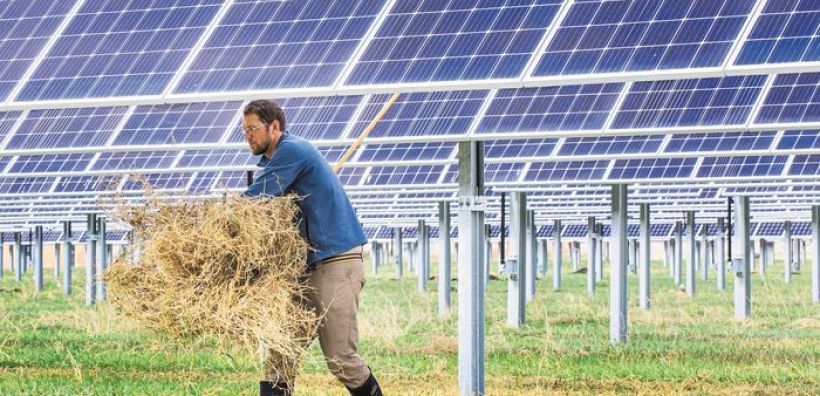
Additional Income for Producers with Agricultural Photovoltaics
Additional income through the installation of photovoltaic systems, without sacrificing “high-productivity land,” is provided in a draft law by the Ministry of Rural Development and Food, which is open for public consultation until Friday, January 19.
Specifically, Article 33 of this draft law allows the production of energy from photovoltaic stations with a installed capacity of up to one megawatt (1 MW) in Producer Groups, on agricultural plots classified as high-productivity land, and in designated areas in the country that have already been identified as high-productivity agricultural land.
“With the provision in our ministry’s forthcoming draft law on agrivoltaic systems, we aim for the dual use of land with the simultaneous coexistence of crops and installations of renewable energy sources on high-productivity land,” said the Minister of Rural Development and Food, Lefteris Avgenakis.
For the acceptance of applications for the issuance of a definitive offer for connection submitted to the competent administrator for the installation of photovoltaic stations with an installed capacity less than or equal to one megawatt (1 MW), engagement in agricultural activity will be required.
Within two months of the law’s approval, a Joint Ministerial Decision is expected to be issued by the Ministries of Rural Development and Food and Environment and Energy. This decision will specify the conditions and procedures for the installation of stations, permitted capacities of photovoltaic stations on high-productivity agricultural land in each Regional Unit, allowed crops, applicant categories, and subsidy rates.
“The types, crops, and cultivation conditions will be indicated by a study. With a joint decision with the Minister of Energy and Environment, Theodoros Skylakakis, the categories of applicants, details, conditions, and procedures for the installation of photovoltaic stations and the exercise of agricultural activity will be determined,” said Minister Avgenakis.
Any intervention on these lands will be allowed only for reasons that serve the agricultural character of the farm or the installation of RES stations, always acting under the terms and conditions set by a joint decision of the two ministries.
According to the Minister of Rural Development and Food, the goal of this regulation is “to ensure the sustainability of farms and the food security of the country. We give producers the opportunity to fully utilize their land and, ultimately, to contribute significantly to the effort to reduce production costs, which is the ultimate goal for all of us.”
The president of the Panhellenic Association of Agricultural Photovoltaics (PSAF), Kostas Spanoulis, emphasized the triple role of agricultural photovoltaics: preserving high-productivity land, ensuring food self-sufficiency, and increasing farmers’ income. He noted that the cost of energy can be a significant portion of production costs for some agricultural operations, reaching up to 30%.
The height of the agricultural photovoltaic installations is expected to start from 2.10 meters and, in some cases, may reach up to six meters in height. According to initial estimates, crops such as vineyards, vegetables, and woody crops can be cultivated under agricultural photovoltaics.
Spanoulis also requests that the installation of agricultural photovoltaics “be added to European programs and Improvement Plans” and notes that the subsidy rates granted should be high to allow producers in our country to cover their installation expenses. Otherwise, he “asks” for the definition of a higher price for the sale of electric energy to the grid.